🌙 Why Deen (Islam) is Needed
Deen is not just a religion but a complete way of life that guides our actions, thoughts, rights, and responsibilities — both in this world and the Hereafter.
✨ Why Deen is Essential for Everyone:
- Gives Purpose of Life: Deen answers the most important question — why are we here? It connects us to our Creator and defines our purpose.
- Mental Peace & Emotional Stability: Deen teaches us tawakkul (reliance on Allah), sabr (patience), and contentment — easing anxiety and depression.
- Protects from Moral Decay: It provides strong moral values, ethics, and boundaries to avoid haram, injustice, and fitnah.
- Teaches Justice, Mercy, and Equality: Islam promotes fairness, kindness to all — regardless of class, gender, or race.
- Helps in Relationships: Deen teaches how to maintain love, respect, and responsibilities in marriage, family, and society.
- Guidance in Trials: In difficulties, Deen gives us tools: Salah, Dua, Qur’an, and community support.
🧕 Why Deen is Especially Important for Women:
- Dignity and Honor: Islam elevates the status of women, giving them rights to education, inheritance, voice, and respect.
- Protection & Respect: Hijab, modesty, and mahram system are to protect her physically and emotionally, not to restrict.
- Her Worship is Valued: A woman gets the same (or more) reward even when serving her family, while men are outside working.
- No Burden of Earning: Islam does not obligate women to earn — she can, but her earnings are hers alone, while men are responsible to provide.
- Spiritual Leadership: Great women like Khadijah (RA), Aisha (RA), Fatima (RA), and Rabia Basri were scholars, entrepreneurs, and worshippers.
❝ Whoever treads a path seeking knowledge, Allah will ease for him the path to Paradise. ❞
— Prophet Muhammad ﷺ (Sahih Muslim)
📖 Qur'an and Hadith References:
- “And We have not created the jinn and mankind except to worship Me.”
— Surah Adh-Dhariyat (51:56)
- “Indeed, the most noble of you in the sight of Allah is the most righteous.”
— Surah Al-Hujurat (49:13)
- “Paradise lies at the feet of your mother.”
— Prophet Muhammad ﷺ (Sunan an-Nasa'i)
Deen is not a burden — it is a blessing. It gives structure, dignity, and success — both in dunya and akhirah.
🌸 Let Us Hold Firmly to the Rope of Allah
Whether we are students, mothers, wives, daughters, fathers, brothers, husbands, professionals — Deen empowers us, purifies us, and strengthens us.
 She Carries the Weight of Wisdom!
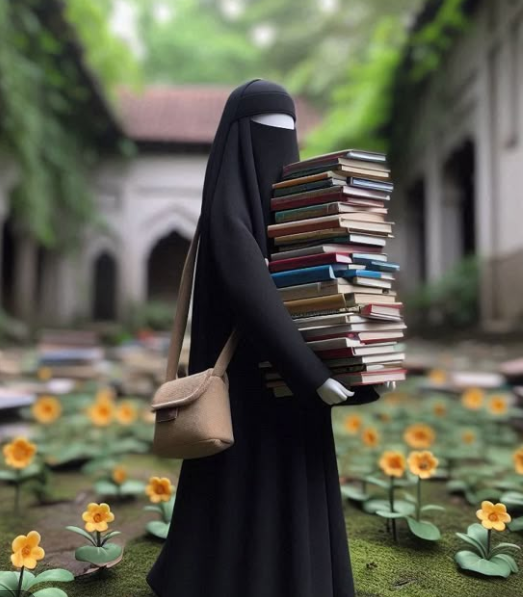
In her hands lie the books of knowledge — Deen and Dunya. She is not just a student or a professional; she is a seeker of truth. From the Qur'an to science, from Hadith to healing — she embraces it all with humility. Islam doesn’t restrict her; it uplifts her, empowers her to learn, grow, and lead with balance and modesty. Like the great women of Islamic history, she is building herself with ilm (knowledge), adab (manners), and ikhlas (sincerity).
She Carries the Weight of Wisdom!
In her hands lie the books of knowledge — Deen and Dunya. She is not just a student or a professional; she is a seeker of truth. From the Qur'an to science, from Hadith to healing — she embraces it all with humility. Islam doesn’t restrict her; it uplifts her, empowers her to learn, grow, and lead with balance and modesty. Like the great women of Islamic history, she is building herself with ilm (knowledge), adab (manners), and ikhlas (sincerity).